Poker is inherently a betting game. In order to make bets, you need money or something that represents money (usually poker chips).
If you are playing very low stakes, or don’t want to invest in a set of chips right away, you can play with actual cash. Just go to the bank or credit union and get pennies, nickels, quarters, and dollar coins. Why no dimes? Typically, at low stakes ($1-$2 or $1-$3) games in casinos, the chip values are $1.00, $5.00, $25.00, and $100.00. Sometimes they will have also have $2.00 chips. Less often they will have $10.00 chips. You can mimic the casino play, learn how to calculate pots and payouts, and get the feel for game flow using coins in the place of chips. If you are really desperate a penny could have the value of $1.00, a nickel $5.00, a quarter $25.00, and a dollar coin $100.00. You will need to insure no one introduces extra coins into the game. An interesting way to do this is to go to a money exchange and get Euro coins for play in the US, and American coins for play in other parts of the world.
You can get inexpensive plastic chips at game stores, poker supply websites, garage sales, or Amazon. Many people start with these chips and then upgrade to clay or ceramic chips after playing for a while. If you order from an online poker supply house, many times you can customize the quantity and value of the chips in your set. Chips are usually sold in packs of 25.
Common colors for chip values are white = $1.00, red = $5.00, light blue = $10.00 (if you use them), green = $25.00, black = $100.00, Purple = $500.00, yellow = $1,000, pink = $5,000, orange = $10,000, and brown = $25.000. If you are going to host both cash games and tournaments, you should have two different styles of chips. One will be your cash chips and the other will be your tournament chips. Your other choice is to limit your cash play to green, $25.00, chips and start your tournament chips at black, $100.00 chips.
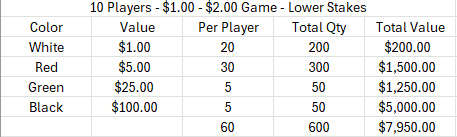
How many do you need? That depends on how many players and what kind of stakes you are playing. When playing cash games most players will buy in for at least 100 big blinds. In a six-hour session, 2 or 3 rebuys is not uncommon for the players that are not doing well. You should have a minimum of 3 buy-ins per player. 600 chips is a common poker chip set size. For a $1.00 – $2.00 no limit hold’em game that could look like this. This set will give all ten players the opportunity to buy in for 100 big blinds, and rebuy three full times (one player will be $50.00 less).
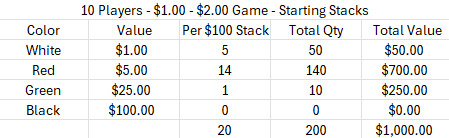
I like to set up initial stacks with the following chips. Each stack will fit in a standard 20-chip tray. Doing it this way ensures you start with enough of an assortment so making change in a pot is easy. Each stack is $100.00. If a player buys in for $100.00 or $200.00, they get one or two stacks, respectively. If they buy in for $300.00, they get two stacks plus four greens. Above that they get one black for each $100.00 additional. Rebuys and add-ons are done with green and black chips.
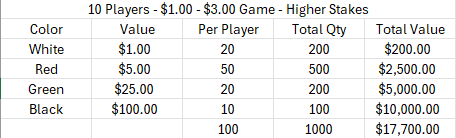
The next larger set of chips is typically 1000 chips. This will allow you to play with deeper stacks or move up in stakes.
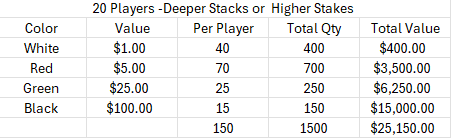
Above 1,000 chips you usually buy multiple sets of 600 or 1,000 chips. Generally speaking, 20 white chips per player is sufficient. If you have a dealer working for tips, or a snack fund where people will be dropping in dollar chips, then you will want extra white, $1.00, chips. Similarly, you can usually get by with 2.5 stacks of red, $5.00 chips, per player. is generally true for red, $5.00, chips. Above the 1,000 chip set, I would add 200 white, $1.00 chips, 200 red, $5.00 chips, 50 green, $25.00 chips, and 50 black, $100.00 chips. This will allow you to run two “normal” tables or one “high roller” table. Obviously, those terms are relative to your bankroll. If you need to run even larger money games for 10 players, just add 200 each of purple, $500.00 chips, and 150 yellow, $1,000.00 chips, and 50 pink, $5,000 chips. This gets you over $500,000 in chips.
For my reccomendations on chip sets for tournament chips, see the “Tournament Chips” post.